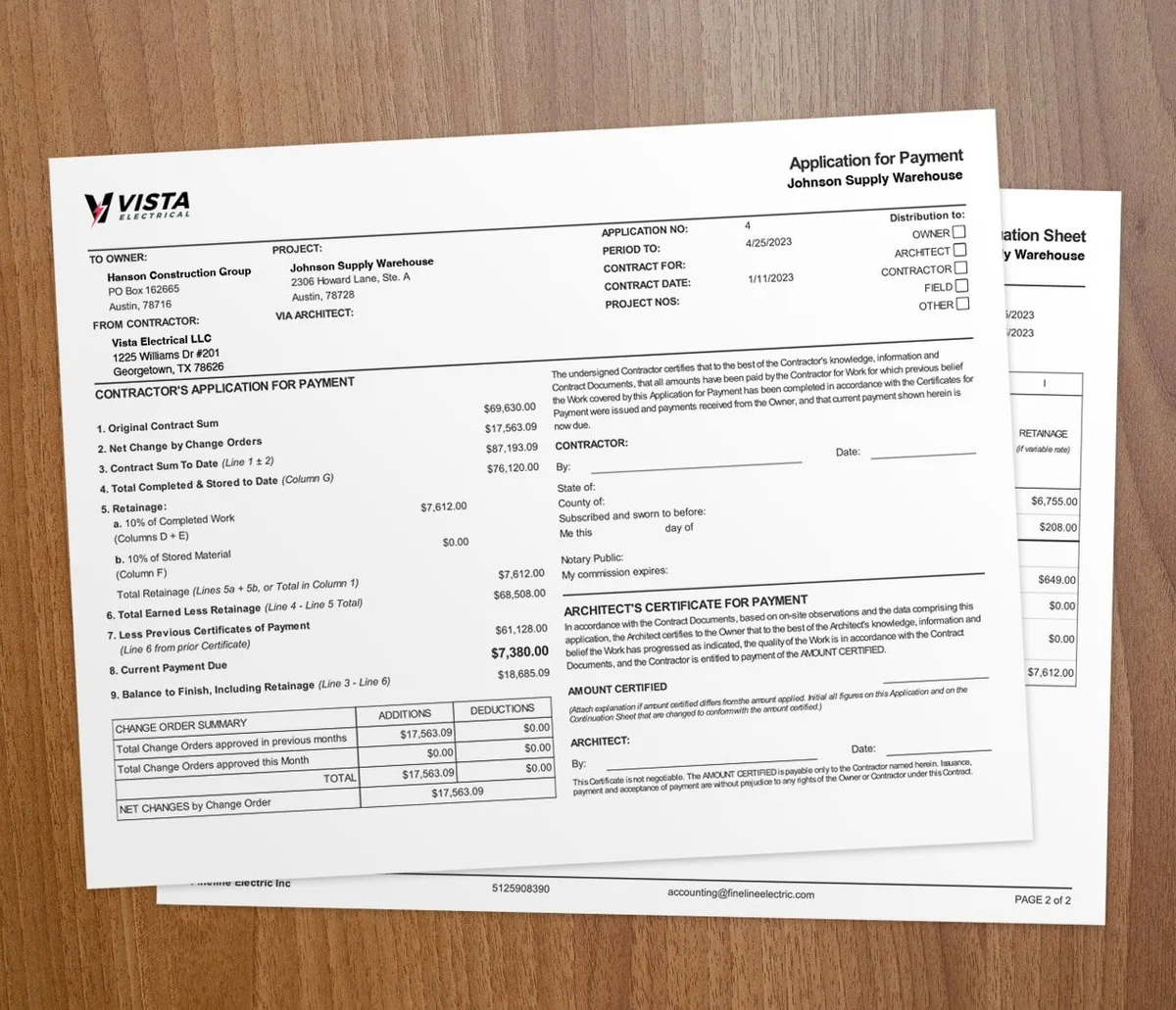

AIA billing is a standardized type of progress billing. Both methods bill for work as it gets done, not all at once. The difference is the format. AIA billing uses fixed G702 and G703 forms and usually needs an architect to certify each pay app.
What is progress billing?
| Line item | App 1 | App 2 | App 3 |
|---|---|---|---|
| Rough-in | 40% | 75% | 100% |
| Panels & gear | 0% | 30% | 60% |
| Fixtures | 0% | 0% | 25% |
Progress billing means you invoice based on the percent of work finished at set points in a job. You do not wait until the end to bill the full amount. Instead, you send periodic invoices for the value of work done so far.
How does progress billing work?
1. You set the total contract value at the start of the project. 2. At set intervals, usually monthly, you figure the percent of work complete. 3. You invoice for that value, minus prior payments and any retainage. 4. The client reviews, approves, and pays the invoice.
Progress billing gives you steady cash flow during a job. You do not have to self-finance the whole project until it ends. For a deeper look, see progress billing and retainage explained.
What is AIA billing?
| 1 | Original contract sum | $266,350.00 |
| 2 | Net change by change orders | $4,046.00 |
| 3 | Contract sum to date | $270,396.00 |
| 4 | Total completed & stored to date | $62,789.85 |
| 5 | Retainage (10%) | $6,278.99 |
| 6 | Total earned less retainage | $56,510.86 |
| 7 | Less previous certificates for payment | $31,240.50 |
AIA billing is a specific, standardized form of progress billing from the American Institute of Architects. It uses set documents, mainly the AIA G702 (Application and Certificate for Payment) and G703 (Continuation Sheet), to create a formal, industry-recognized process.
How does AIA billing work?
1. You break the contract into a detailed schedule of values on the G703, with each part of the work and its value. 2. Each billing period, you fill in the percent complete for every line item. 3. The G702 summarizes the application, with total earned, retainage held, and amount due. 4. The architect or project manager reviews and certifies it before the owner pays.
Werx's AIA billing feature automates this. It builds the formatted documents and tracks progress across billing periods.
What are the key differences?
Standardization
This is the biggest difference. Progress billing is a general idea that can take many forms. AIA billing follows one nationally recognized format, so it stays consistent across projects and parties.
Documentation
AIA billing needs more detail. You keep a full schedule of values and run the two-form application each cycle. That detail adds clarity but takes more setup. For a quick primer, see progress billing vs AIA billing.
Industry acceptance
AIA documents are the standard in commercial construction. GCs, owners, and lenders often require them. Residential and smaller commercial jobs may use simpler progress billing.
Third-party review
AIA billing usually involves architect or engineer review and certification before payment. Standard progress billing may skip that middle step.
When should you use each method?
Use AIA billing when:
- The contract or client requires it
- You work as a subcontractor on commercial projects
- The project has a complex scope with many line items
- The client or lender requires formal payment certification
- You want strong legal protection through standardized documents
Use progress billing when:
- You work on residential jobs where AIA forms would be overkill
- The client prefers a simpler invoice
- The scope is straightforward with few line items
- You need a quick, flexible billing format
Best practices for both methods
Keep accurate records
Accuracy matters in both methods. Over-billing, claiming more work is done than is true, breaks trust and can trigger clawbacks. Under-billing leaves money on the table and hurts cash flow. Track labor and actual progress against your schedule of values.
Bill on time, every time
Submit invoices on the same schedule each period. Late submissions delay payment and can push your invoice to the next cycle. That creates a multi-week cash flow gap.
Track retainage
Both methods usually hold back retainage, a percent of each payment kept until completion. Retainage runs 5% to 10% on most jobs. Track held balances and request release promptly when eligible. For the details, read our AIA retainage billing guide for G702 and G703.
Connect to accounting
Send your billing data into QuickBooks or your accounting system. That keeps records accurate and supports job costing.
Can you run both billing methods at once?
Yes. Many contractors use different methods across their projects. A progress billing platform that supports both AIA and standard progress formats lets you manage every job in one system, whatever the contract requires.
Key takeaways
- AIA billing is a standardized form of progress billing, not a separate idea.
- Progress billing can take many shapes; AIA billing uses fixed G702 and G703 forms.
- AIA billing usually needs architect certification; standard progress billing may not.
- Use AIA when the contract requires it; use simple progress billing on smaller jobs.
- Both methods hold 5% to 10% retainage, so track held funds and request release on time.