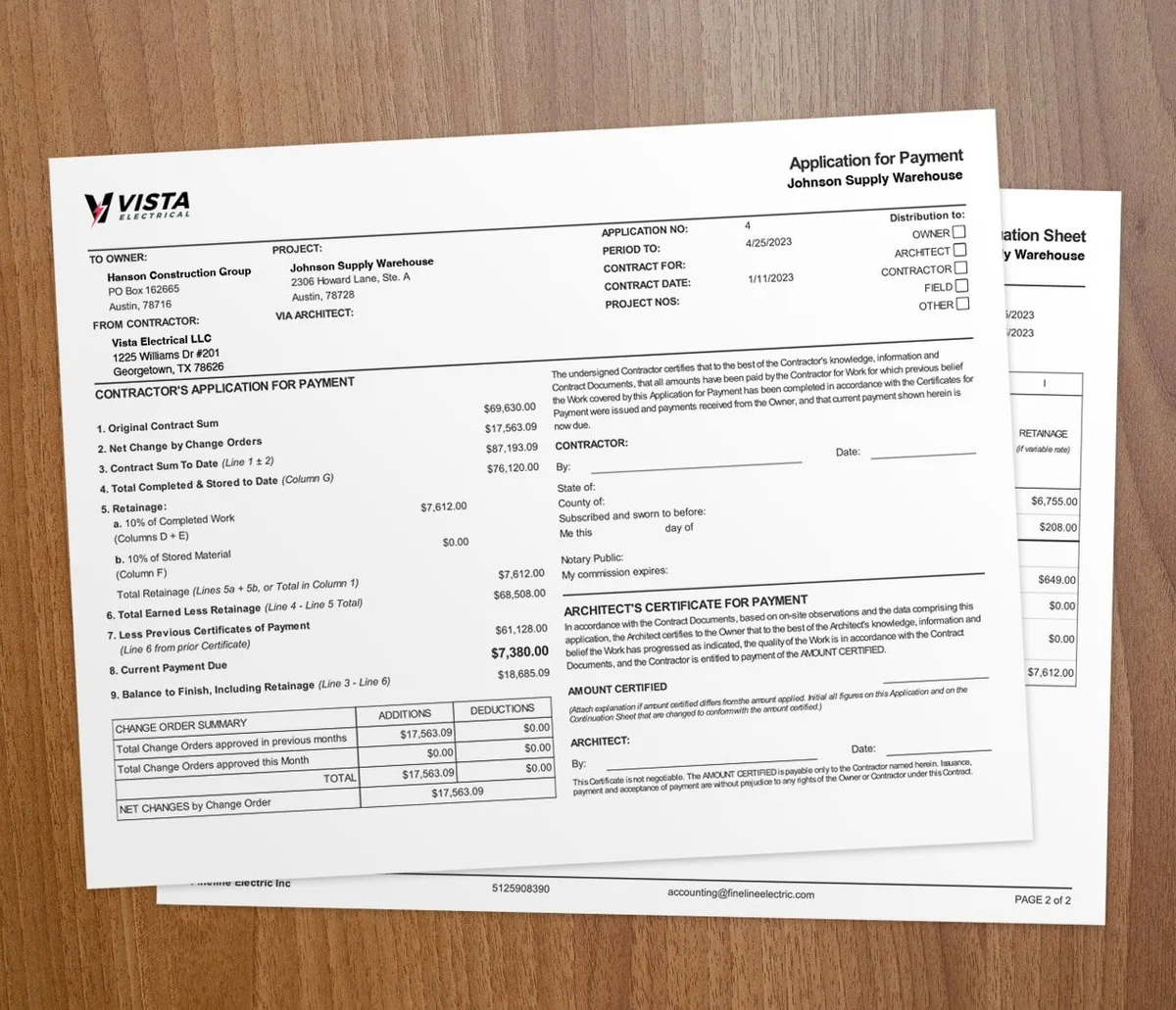

Progress billing lets you invoice for work as you finish it, instead of waiting for the whole job to wrap. You bill by phase or percent complete, so money comes in while your costs go out. Pair it with retainage and you have the two levers that decide cash flow on most commercial jobs.
What is progress billing?
Progress billing is invoicing tied to how much of a job is done. You split the contract into line items on a schedule of values, then bill the percent complete on each line. The owner pays for verified progress, not promises.
Say a job is worth $1 million and you are 50% done. You can invoice for $500,000 at that stage, minus any retainage. Most commercial work runs on a monthly billing cycle with net-30 or net-60 terms.
Progress billing helps you:
- Keep cash flowing to cover labor and materials as they hit
- Show owners exactly what they are paying for each month
- Cut disputes by tying every dollar to completed work
- Keep stakeholders on the same page about progress
Want the deeper version? See our guide on what progress billing is and how it compares to other methods.
| Line item | App 1 | App 2 | App 3 |
|---|---|---|---|
| Rough-in | 40% | 75% | 100% |
| Panels & gear | 0% | 30% | 60% |
| Fixtures | 0% | 0% | 25% |
What is retainage?
Retainage is the part of each payment the owner holds back until the job is done. It protects the owner by giving you a reason to finish strong and fix punch-list items before the last check clears.
Retainage usually runs 5% to 10% of each progress payment, though it varies by contract and state. On a $100,000 invoice with 5% retainage, you collect $95,000 now and the owner holds $5,000. Track every held dollar so you can collect it later. Our free retainage calculator runs this math for your own contract numbers.
To manage held funds without a spreadsheet mess, see how Werx handles retainage tracking.
| Billing period | Work billed | Retainage held (10%) | |
|---|---|---|---|
| 1 | Application 1 | $22,000 | $2,200 |
| 2 | Application 2 | $34,500 | $3,450 |
| 3 | Application 3 | $28,700 | $2,870 |
How does AIA billing fit in?
AIA-style billing is the standard format many owners and architects expect on commercial jobs. The G702 and G703 forms lay out the schedule of values, work completed, and retainage in one place. That structure is why so many GCs use it for progress billing.
AIA billing gives you:
- A standard layout that reduces errors and back-and-forth
- A clear progress story that builds owner trust
- Documentation that matches most contract requirements
If you are weighing formats, read progress billing vs AIA billing before your next contract.
How do you manage progress billing and retainage?
Good process beats good intentions. These four habits keep payments clean:
1. Know your contract. Confirm the billing schedule, retainage percent, and release terms before work starts. 2. Keep records. Track work completed, amounts billed, and retainage held on every pay app. 3. Communicate often. Regular updates to owners and architects cut surprises at payment time. 4. Use the right tools. Progress billing software handles pay apps and retainage so you bill faster and chase less.
When should you use progress billing?
Use progress billing on long jobs done in phases, like commercial builds, remodels, and multi-month projects. It fits any time waiting until the end would starve your cash flow.
Stick with a simple invoice on short, one-visit jobs. The pay-app paperwork is not worth it for a half-day repair. For ongoing work, progress billing plus retainage tracking is the safer call.
Key takeaways
- Progress billing invoices for work as it gets done, tied to a schedule of values.
- Retainage holds back 5% to 10% of each payment until the job is nearly complete.
- AIA G702/G703 forms are the common format for progress billing on commercial jobs.
- Track every billed and held dollar so you collect retainage and avoid disputes.
- Contractor software like Werx automates pay apps and retainage so cash keeps moving.